


Is the world’s commercial shipping fleet still buying the LNG bridge story?
It is, but the percentage of enthusiastic buyers is shrinking. Sales pitches fall flat when geopolitics holds a vital energy corridor hostage.
They lose more traction when uncertainty prevails, and ocean carriers are navigating uncertainty in everything from regulatory and enforcement complications to fuel technology and infrastructure availability, and bottom-line economic buoyancy.
Still, when it comes to a bridge to lower greenhouse gas emissions, more shipping bets are still riding on liquefied natural gas, despite the warning signs en route to that bridge.
Gisele Widdershoven points to three in a recent analysis.
The energy transition expert notes, for example, that collateral damage from the Strait of Hormuz crisis includes LNG bunkering reliability, which depends on free-flowing gas-export corridors.
The U.S.-Iran conflict volatility, she writes, “has reminded the market that LNG supply is not just a commodity chain but also a military geography.”
Flashing warning sign No. 2, according to Widdershoven, is the stricter maritime emissions obligations coming into force with the European Union’s Emissions Trading System (ETS). Methane and nitrous oxide are being added to carbon dioxide in 2026 under the ETS.
While LNG eliminates virtually all sulphur and nitrogen oxides and cuts carbon dioxide emissions by around 25% compared with heavy marine oil, well-to-wake methane slip remains an issue for LNG.
The delayed adoption of the International Maritime Organization’s Net Zero Framework has added another layer of uncertainty to ocean carrier alternative fuel investment.
Widdershoven’s third warning sign is market sentiment.
She noted that orders for alternative-fuel ships in 2026’s first half dropped to 137 compared with 155 in 2025’s first six months.
Widdershoven cited data from maritime industry risk-management company DNV showing orders for alternative-fuel ships had decreased 45% in 2025 compared with 2024.
So, availability, reliability, and emissions reduction – all foundational LNG bridge sales supports – face varying stress tests today.
As Widdershoven concludes: “LNG can remain part of shipping’s transition, but only if the sector stops selling it as a clean destination and starts managing it as a risky bridge.”
Risky or not, it remains the dominant bridge of choice for ocean carriers, well ahead of other options.
Yang Chen, the managing director and chief editor of Xinde Marine News, points out in a recent analysis that, according to data from Clarksons, a U.K.-based maritime and shipping research company, 173 LNG-capable ships were ordered in 2026’s first half compared with only four methanol ships.
He added that ammonia and hydrogen remain marginal alt-fuel shipping options at best.
Hydrogen’s low-carbon ship fuel ambitions keep drifting further and further into the future.
In his foreword to DNV’s Hydrogen to 2060 report, Ditlev Engel, the company’s CEO of energy systems, wrote that “at the expensive end of decarbonization, clean hydrogen has suffered disproportionately (along with carbon capture and storage) with cutbacks and delays to policy support. As a result, we have scaled back our long-term forecast for clean hydrogen (to 2050) by 45%.”
Again, citing data from Clarkson’s, Chen said 246 of the 1,625 vessels ordered by global shipowners in 2026’s first half included technology to operate on fuels other than standard heavy marine oil.
Containerships and car and truck carriers accounted for 78% of the dual-fuel vessels ordered.
LNG availability has also expanded significantly over the past decade.
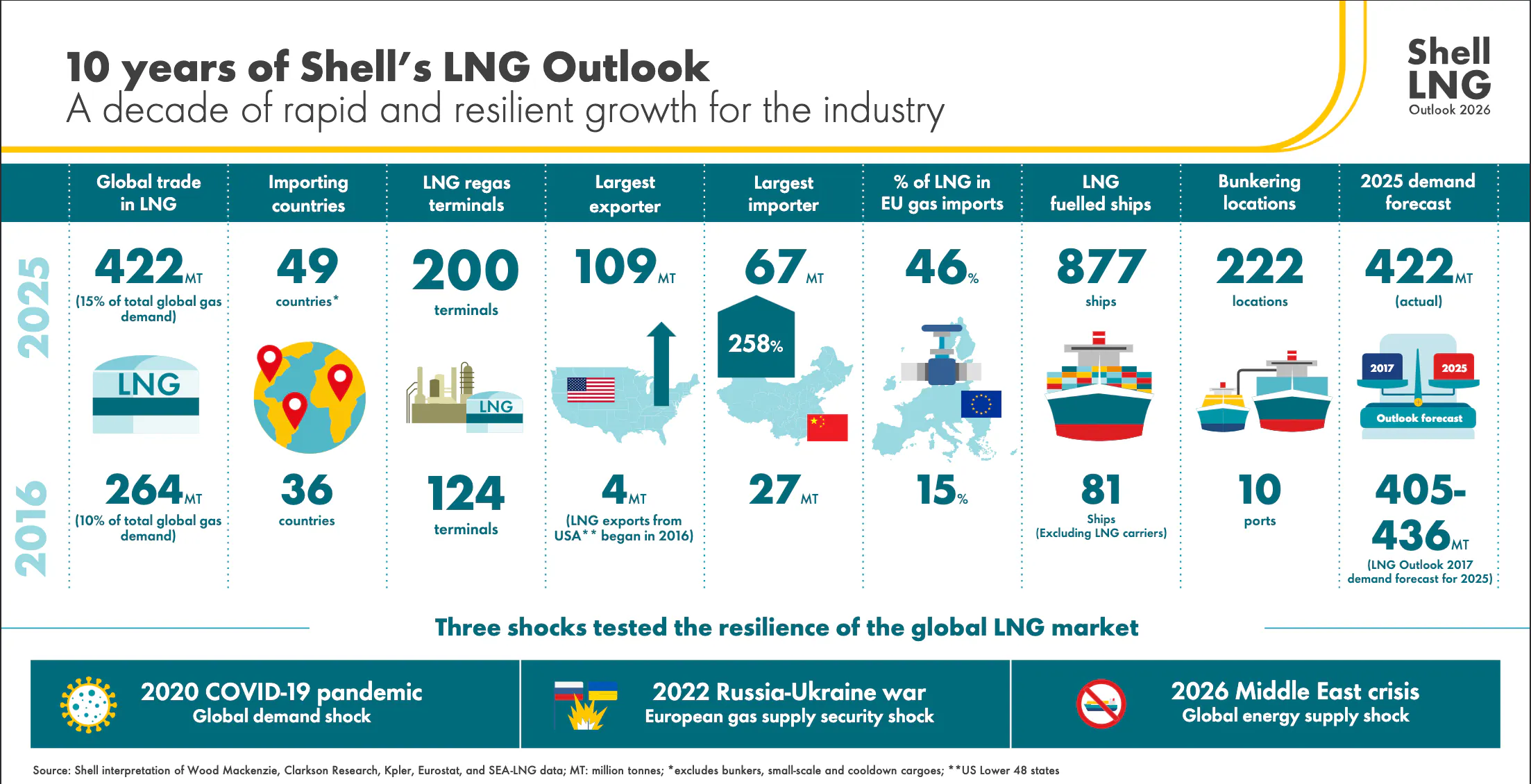
According to Shell’s (LON:SHEL) LNG Outlook 2026, the number of LNG bunkering locations around the world has grown 2,120% to 222 in 2025 from 10 in 2016, while the fleet of LNG-fuelled ships increased 983% to 877 from 81 during the same period.
The good news for B.C. in the LNG bridge sales resilience story is the potential for the province to not only provide the tidewater infrastructure for more Canadian LNG exports into an LNG-hungry world but also establish B.C. as a transpacific LNG bunkering hub.
www.linkedin.com/in/timothyrenshaw
@timothyrenshaw