Modulation Index (MI)
With the diversification of energy sources, a need arose to differentiate their costs based on their "delivery" characteristics.
Simply put, there are two types of energy in our Brazilian grid mix: firm and non-firm.
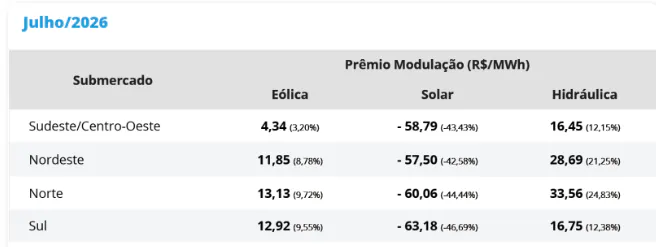
And, naturally, the costs of production and dispatch management differ. In fact, they differ significantly, as shown in this table (Dcide).
A source incurs an economic loss when the MI is negative—relative to a flat profile—due to concentrating generation during hours with lower spot prices or generating when prices are low at a specific time. Solar power is a prime example of this.
In the cases of wind and hydroelectric power shown in the table, the MI is positive, representing an economic gain.
It makes perfect sense!
Firm energy sources see a gain, while non-firm sources see a loss. Yet, in Brazil, non-firm energy sources are subsidised—despite these losses!