


Energy storage remains the chief inhibitor in our quest to move from fossil fuel-derived energy to that which we can glean from the sun, wind, and waves. These three energy sources suffer from one common problem, intermittency. If we can store the excess energy we can derive from them then intermittency goes away. But until now we have been trying to use chemical-based batteries the primary storage method which means we add a level of complexity to energy solution. What’s needed is simplicity.
Think of it this way. If the sun heats water in a tank next to an array of photovoltaic panels, then we have captured the energy of our star twice. When the sun goes down, the water with its trapped heat is, in fact, an energy storage sink, albeit not a terribly useful one except for taking a shower or bath. So find a medium other than water that is more efficient at transferring solar energy and converting it to heat and we have a potential storage technology that can be used to power our lights, heating, and air conditioning after the day is done.
So what are likely candidates to create adjunct storage for renewable energy technologies to create a continuous, reliable supply of electricity?
- Compressed air – pressurizing air using the excess energy produced by renewable sources is not a new idea. Known in the industry as CAES (Compressed Air Energy Storage) the concept is very simple. Build an air-tight storage tank, or find a natural one such as an underground reservoir, cavern, or mine (salt mines work really well) and install compression equipment on the surface with pipes connected to your storage locale. When the sun sets or the wind dies, release the compressed stored air which then powers a turbine connected to a generator.
- Carbon dioxide (CO2) – using captured CO2 is seen as a way to turbocharge existing thermal power plants. Whether as a supercritical fluid or just liquefied CO2, the potential to turn this greenhouse gas into a power generating technology that can be integrated into both existing thermal-based as well as renewable energy systems has led to some early turbine prototypes that can handle the liquid or supercritical state of the CO2.
- Norbornadiene – a liquid hydrocarbon may prove to be the best thing that ever happened to solar energy. Combined with photovoltaic panels the norbornadiene chemically is altered when exposed to light turning it into quadricyclane, a chemical with energy densities similar to high-performance batteries. This photochemical reaction is being called “solar fuel” and in a closed system fuel cycle could generate power from photovoltaic cells continuously 24×7.
- Molten salt – is increasingly being seen as the answer to large-scale energy storage. Using the excess energy produced by renewable sources to heat the salt it becomes a stable storage medium. Today salt is being used this way in solar thermal energy plants that focus the light of thousands of mirrors to convert the energy to heat which is then stored in the molten salt, and later released to produce steam to drive turbines connected to generators.
- Molten silicon – is based on the same concept as molten salt, but the advantage silicon gives is its much easier to store than salt because it doesn’t corrode the storage medium in which it is placed. Another advantage is liquid silicon’s thermal gradient. Silicon can be heated to temperatures 2 to 4 times higher than molten salt which creates even greater latent energy. Heat-tolerant pumps developed by MIT engineers can handle the high temperatures of molten silicon and through heat exchangers capture the energy to drive steam turbines.
- “Sun in a box” – also called TEGS-MPV (Thermal Energy Grid Storage-Multi-Junction Photovoltaics) uses the excess electricity produced by any renewable source by passing the current through a heating element. The energy is then absorbed by molten silicon which turns glowing white when it reaches temperatures of 2,370 Celsius (4,300 Fahrenheit). The light from the silicon is then turned into electricity by multijunction photovoltaics, specialized solar cells. The electricity generated by the solar cells can then be used for HVAC systems and lighting. The MIT engineers who have proposed the “Sun in a box” believe a single storage system combined with wind and solar systems could continuously power a small city of 100,000 homes. The system would cost half the amount of current pumped hydroelectric storage energy systems, which currently is the least expensive mass energy storage technology on the market.
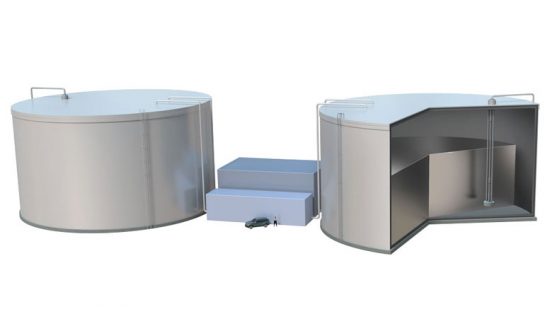
The “Sun in a box” concept is pictured here, a system to store excess power from solar and wind energy by heating liquid silicon turning it white hot. The tanks needed for this technology would probably be built of graphite so that they would be hot inside but cool to those touching the wall from the outside. (Image credit: Duncan MacGruer)